Every machine that leaves Pragya's manufacturing facility at Pithampur Industrial Area, Madhya Pradesh, goes through the same underlying process regardless of whether it's a coil-handling hook, a solvent extraction machine, or a custom special-purpose unit: structural design, fabrication to certified material standards, non-destructive testing, and load testing before dispatch. The equipment differs; the process discipline doesn't.
Structural design starts with analysis, not assumption
Before any steel is cut, load-bearing components go through Finite Element Analysis (FEA) — a computational method that models how a structure will actually behave under load, rather than relying on rule-of-thumb sizing. For a C hook, this means optimising the arm's cross-section to achieve the required safe working load at minimum dead weight, which preserves the crane's net lifting capacity. The same analytical approach applies to any structural component carrying a rated load — our C hook types and selection guide shows how that analysis feeds a real specification.
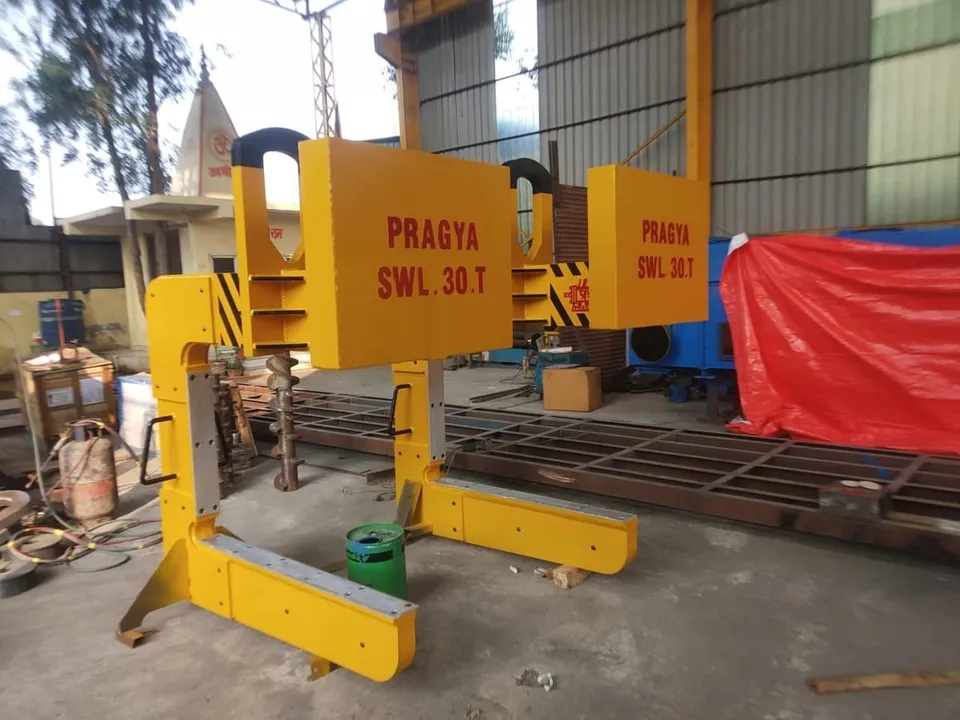
Fabrication by coded welders, from certified plate
Structural fabrication uses IS/EN-certified steel plate, and welding is performed by coded welders — welders certified to a recognised welding procedure standard, which matters because weld quality on a load-bearing joint is a safety-critical variable, not a cosmetic one. Material traceability back to certified plate means the manufacturer (and the customer) can verify exactly what steel grade went into a given component.
Non-destructive testing before anything ships
After fabrication, welds on load-bearing equipment undergo NDT — non-destructive testing, most commonly magnetic particle inspection, which detects surface and near-surface cracks or defects in a weld without damaging the part. This step catches fabrication defects that would otherwise only surface once the equipment was in service and under load, which is far too late to find them.

Proof load testing as a final check
Before dispatch, lifting equipment is proof load tested — typically at 125% of its rated safe working load — to confirm the finished component performs as designed under a load exceeding normal operating conditions. Equipment ships with its test certificate, safe working load marking, and as-built drawing, giving the customer documented evidence of what they're installing, not just a manufacturer's assurance.
Why this process applies across every product line
The specific standards referenced — IS 3815, EN 13157, ANSI/ASME B30.20 — vary by product category, but the underlying discipline is the same across steel handling and testing equipment and solvent extraction machinery: design with analysis, fabricate to certified material and welding standards, verify with non-destructive testing, and confirm performance with load testing before the customer ever sees the machine. It's a slower process than skipping any of these steps, but it's the reason equipment built this way tends to run reliably for years without unplanned structural failures — more about how we work.
Availability in India
Designed and built at Pragya's Pithampur (Indore) works and supplied to plants across India. Equipment is fabricated to the relevant IS standards, delivered by road to your site, and installed and commissioned by our own engineers, who also train your operators.
Interested in our industrial equipment?
Our engineering team, based in Indore, Madhya Pradesh, India, will recommend the right solution for your plant requirements.
Request a quote