Galvanising lines run continuously, so coil handling equipment feeding them has to maintain steady tension and uninterrupted material flow — a stopped line is lost production, not just a delay.
Continuous feed is the design constraint
Unlike batch handling at a mill's coiler or a service centre's cutting station, a galvanising line is a continuous process: strip runs through cleaning, annealing, and the zinc bath at a set line speed. Equipment upstream of the line has to keep pace with that speed without introducing tension variation that shows up as coating defects or strip breaks.
Uncoilers and recoilers for continuous strip feed
Uncoilers unwind the incoming coil to feed the line; recoilers rewind the coated strip at the line's exit. Pragya's uncoiler/recoiler systems handle coil weights from 5 to 60 ton and widths from 152–1829 mm, with coil OD up to 1400 mm and material thickness from 0.4–3.4 mm. Hydraulic mandrel expansion grips the coil ID securely for unwinding, while tension control and variable-speed, synchronized drives keep the strip feeding smoothly rather than in surges. Pressing arms on the coil hold it against loosening during the unwind, which matters on a continuous line where a loose wrap can introduce slack that the tension control system then has to correct for. Strip leaving the line often runs through a plate leveler before cutting — what that stage corrects.
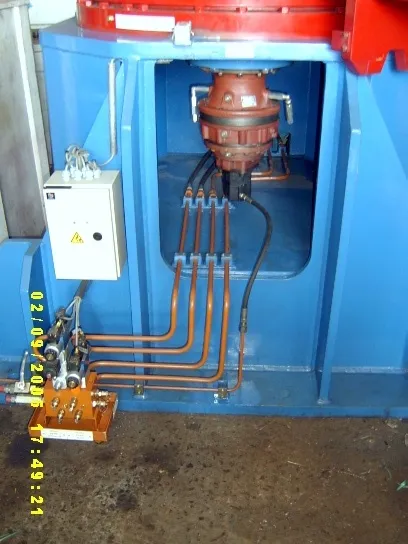
Turnstiles for coil changeover
Because galvanising lines don't stop, getting the next coil into position — and often welding its leading edge to the tail of the current coil — has to happen without interrupting feed. Turnstiles, rated up to 70 ton in Pragya's range, provide the rotation needed to bring a new coil into the uncoiler position for changeover, in either manual or hydraulic actuation. Positioning the next coil accurately before the current one runs out is what keeps changeover time short and avoids an unplanned line stop. See the turnstile's role in coil and strip processing lines.
What to specify
For a galvanising line, the uncoiler/recoiler and turnstile need to be sized around the line's actual coil range — width, OD, weight, and gauge — and around the target changeover time, not just peak tonnage. A system rated for the heaviest coil but with mismatched width capacity, or tension control tuned for the wrong gauge range, will underperform even if the headline capacity number looks adequate on paper.
Why this differs from batch handling equipment
Equipment specified for a galvanising line generally can't be the same equipment used for batch handling elsewhere in the plant, even if the tonnage rating looks similar on paper. A coil car or trolley used to move coils between storage and the line entry point is a batch handling device — it makes one trip, sets the coil down, and is done. The uncoiler, recoiler, and turnstile at the line itself are continuous-duty equipment, expected to hold tension and position accurately for the full length of a coil, shift after shift. Buyers evaluating galvanising line equipment should ask specifically about duty cycle ratings and tension control tuning range, not just the maximum tonnage a data sheet lists. Talk to our engineering team with your line speed and gauge range to hand.
Availability in India
Designed and built at Pragya's Pithampur (Indore) works and supplied to rolling mills, service centres, and steel plants across India. Equipment is fabricated to the relevant IS standards, delivered by road to your plant, and installed and commissioned on site by our own engineers, who also train your operators.
Interested in our industrial equipment?
Our engineering team, based in Indore, Madhya Pradesh, India, will recommend the right solution for your plant requirements.
Request a quote