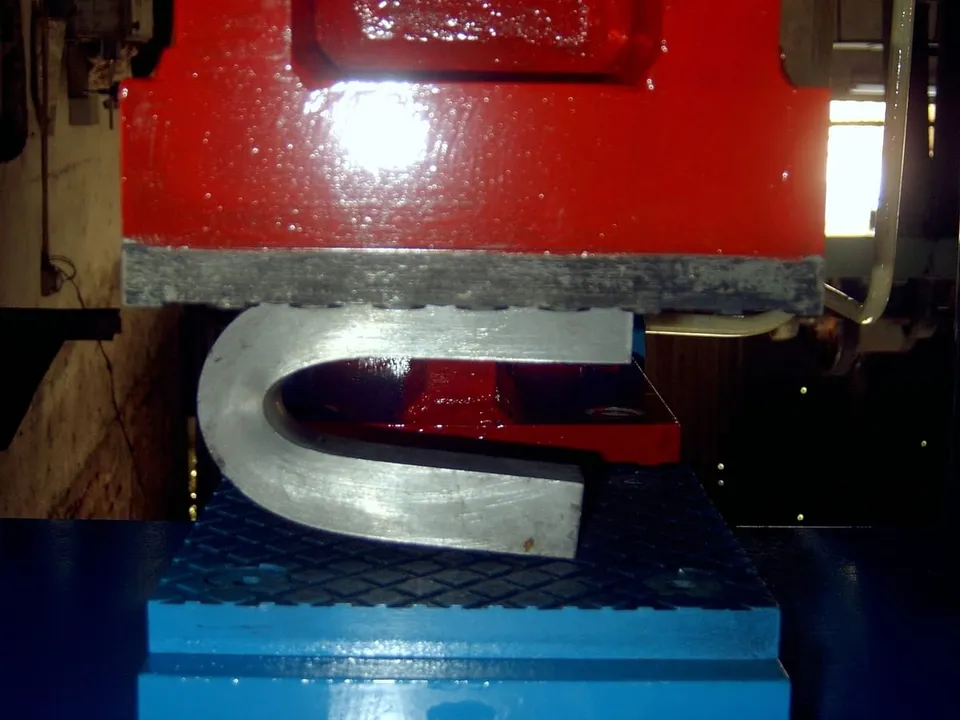
A bending and folding machine is a testing machine, not a fabrication one. It bends and folds steel specimens and tears samples, so a plate can be proved before it goes into service. The bed and tooling are built to suit the plate rather than to a fixed working length, and a specimen can be folded right back on itself through 180°.
What the machine does to a specimen
Three operations, all destructive, all carried out on a sample rather than on production work:
- Bend — the specimen is bent under the ram to the angle the test calls for.
- Fold — the same operation taken further, until the specimen lies flat back on itself at 180°.
- Tear — the sample is torn so the fracture can be examined.
Specifications
- Plate capacity: to suit plate size
- Bending force: up to 250 ton
- Tests: bend, fold and tear
- Fold angle: to 180°
- Drive: hydraulic ram, geared motor
Why plate is bend tested at all
A bend test is a cheap and direct check on ductility and soundness. Steel that will crack when it is worked cold usually shows it on the outer face of a bend long before anything subtler does, and a fold to 180° is the severest form of that check — it stretches the outer fibre as far as the geometry allows. What counts as a pass, and how much cracking is permitted, comes from the specification the plate is being supplied against rather than from the machine.
Sized to the plate, not to a fixed working length
The bed, the tooling and the ram are built around the plate you intend to test, which is why the capacity line reads "to suit plate size" rather than a working length in millimetres. A folding machine sold for fabrication is the other way round: it is built to a fixed length and thickness, and the work has to fit it. That difference matters when specifying — the question is not how long the machine is, but whether it will take the specimens your material specification calls for, at the force needed to fold them.
Where it sits next to the drop weight tear tester
Both machines break steel deliberately, but they answer different questions. The bending and folding machine loads a specimen slowly and steadily, and what is read off it is whether the material will take that deformation without cracking. The drop weight tear tester loads it in an instant, from a falling tup, and what is read off it is how the fracture propagates — brittle or ductile — which is the property that matters for a pipeline. A plate mill that runs both is checking cold ductility on one machine and fracture behaviour on the other.
Frequently asked questions
Is the bending and folding machine used for production work?
No. It is a testing machine. Specimens are bent, folded and torn so plate can be proved; it is not built for fabricating ductwork, panels or enclosures, and it is not sold as a press brake or a production folder.
How far will it fold a specimen?
To 180° — flat back on itself. That is the severest bend a specimen can be given, and it is what the machine is built to do.
What size plate can it test?
The bed and tooling are built to suit your plate size rather than to a fixed working length, so the machine is specified around the specimens you need to test. Bending force is built to 250 ton.
How is it different from the drop weight tear tester?
The bending and folding machine loads the specimen slowly and shows whether the steel cracks when it is deformed. The drop weight tear tester loads it in an instant and shows how a fracture runs through it. They test different properties and neither substitutes for the other.
Availability in India
Designed and built at Pragya's Pithampur (Indore) works and supplied to rolling mills, service centres, and steel plants across India. Equipment is fabricated to the relevant IS standards, delivered by road to your plant, and installed and commissioned on site by our own engineers, who also train your operators.
Interested in our industrial equipment?
Our engineering team, based in Indore, Madhya Pradesh, India, will recommend the right solution for your plant requirements.
Request a quote