The short answer: a scissor-type trolley transports and lifts material vertically up to 35 ton using a hydraulic scissor mechanism, while a trolley with tilter adds 0–90° tilting to the transport function in a single unit. Choose based on whether your process needs the material rotated, or just moved and raised.
How a scissor-type trolley works
A hydraulic scissor mechanism lifts the platform vertically while the trolley itself provides transport, with capacity up to 35 ton and adjustable lifting height. It's available in standard, heavy-duty, and self-propelled configurations, with manual or motorized drive depending on the installation. The design is purpose-built for combined transport-and-lift where the load stays in the same orientation throughout. Our guide to how a scissor-type trolley works covers the mechanism in more detail.
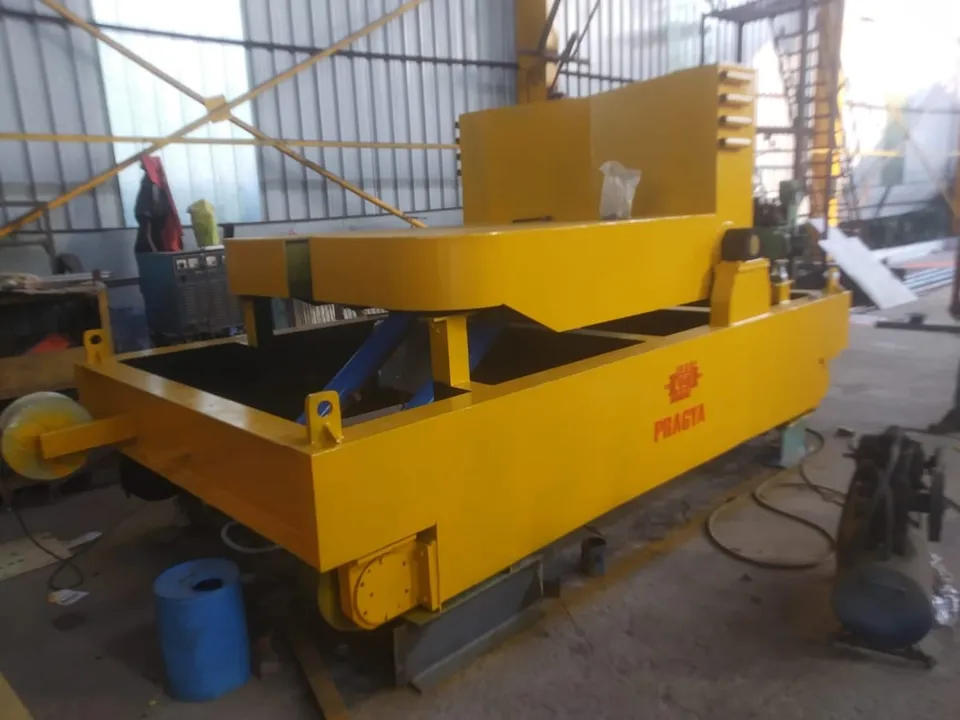
How a trolley with tilter works
A trolley with tilter combines transport with hydraulic tilting in one unit, rotating the load through 0–90° rather than just lifting it vertically. Variants include a hydraulic trolley with tilter for smooth, controlled rotation, a motorised trolley with tilter for self-propelled operation, and a heavy-duty version for higher-capacity loads. This eliminates the need for a separate tilting station in the line — see combining transfer and tilting in one machine.
Side-by-side
| Scissor-Type Trolley | Trolley with Tilter | |
|---|---|---|
| Primary motion | Vertical lift | 0–90° tilt (plus transport) |
| Capacity | Up to 35 ton | Customizable |
| Drive | Manual or motorized | Manual or motorized |
| Mechanism | Hydraulic scissor | Hydraulic tilting |
| Best suited to | Height positioning without reorientation | Combining transport with rotation in one step |
Which one fits your job
If your process just needs material raised or lowered to a working height — feeding a line, matching a dock height, or positioning for an operator — the scissor-type trolley's vertical lift covers that without adding rotation you don't need. If your process requires the material reoriented (for example, presenting a different face or changing a coil's axis) as part of the transfer, the trolley with tilter folds that step into the same move instead of requiring a separate tilting station downstream. Combining both functions into fewer machines usually pays off in floor space and cycle time where your line genuinely needs both lift and tilt at the same point.
Construction and maintenance considerations
Both machines share heavy-duty steel construction and hydraulic actuation as the core lifting or tilting mechanism, so day-to-day maintenance needs are broadly similar — checking hydraulic fluid condition, inspecting seals, and verifying safety interlocks. The trolley with tilter has one more moving subsystem than the scissor trolley (the tilt mechanism in addition to transport), which means slightly more to inspect on a maintenance schedule, but that's the cost of the added function rather than a sign of extra complexity for its own sake. Self-propelled and motorized variants of both machines add a drive system to maintain as well, which is worth weighing against a manually-pushed unit if your floor layout allows for either.
Availability in India
Designed and built at Pragya's Pithampur (Indore) works and supplied to rolling mills, service centres, and steel plants across India. Equipment is fabricated to the relevant IS standards, delivered by road to your plant, and installed and commissioned on site by our own engineers, who also train your operators.
Interested in our industrial equipment?
Our engineering team, based in Indore, Madhya Pradesh, India, will recommend the right solution for your plant requirements.
Request a quote